
Fictional Characters as Dependent Intentional Objects
A Summary of Amie Thomasson's theory of dependence
Previously, we commented on Amie Thomasson’s “Fiction and Intentionality. In that article, Thomasson argued for what she called ‘Intentional Object Theory’, which holds that fictional characters must be understood as objects of intentional acts; that is, there is something that discourse concerned with fictional characters is about, namely, the fictional characters themselves, and thus talk about fictional characters cannot be paraphrased away. There are fictional characters just as much as there are tables, trees, and you. Nonetheless, it’s also obvious that fictional characters, as intentional objects, have some relatively distinctive characteristics (I say ‘relatively’, because as we’ll see, fictional characters share their features with a few other things, like literary works). The way Thomasson attempts to pin down these features is by looking at dependence. We absolutely have to look at this theory; Thomasson’s theory of dependence (generalizing prior work by Husserl and Ingarden) is arguably the single most important theory in philosophy of fiction, and, as we have repeatedly pointed out, anything important in philosophy of fiction will have important ramifications for other areas of philosophy.
The theory of dependence is intended to be quite general, but the particular form of dependence that is useful for our purposes is existential dependence, whose basic structure can be summarized as “Necessarily, if A exists, then B exists".1 However, even given this structure, we find a significant diversity in kinds of dependence. In particular, Thomasson identifies two major distinctions for kinds of dependence.
KINDS OF DEPENDENCE
Rigid dependence arises, intuitively, when something is dependent on a particular individual or ‘token’. In the sense that is meant here, ‘individual’ is quite broad, and can include individual partnerships, particular groups, and the like. When X rigidly depends on Y, Y is a determinate particular. For instance, your existence depends rigidly on your parents; you exist as a biological organism through a dependence on these two particular people.
Generic dependence arises when something is dependent in some way on a ‘type’ or ‘kind’ of thing. When X generically depends on Y, Y is a particular case of kind of thing, in such a way that Y could in principle be replaced by a different particular case (call it Z). That is, in generic dependence, you don’t need the thing on which the other depends to be this very thing; it could be any other thing that met certain requirements. A fire that depends on oxygen does not require that the oxygen be these particular oxygen molecules that happen to be there; any oxygen would do.
If X rigidly depends on Y, then X also generically depends on Y’s type. For instance, if you rigidly depend on the beating of your heart, you generically depend on some kind of organ beating.
With rigid vs. generic dependence, we are dividing kinds of dependence according to that on which they depend. However, we can also divide kinds of dependence according to the durations covered by the dependence.
Constant dependence is when the dependence covers the whole duration of what is dependent. That is, if X constantly depends on Y, then Y’s dependence on X occurs whenever Y exists. You are constantly dependent on the vital activities of your essential organs; when they stop, you stop. Being able to drive legally is constantly dependent on having a valid driver’s license. The Moon’s orbit constantly depends on the Earth. We can have constant dependence relations between many different kinds of things. For instance, many of your features or properties are constantly dependent on being human — assuming that you are human, of course.
Historical dependence is intuitively about beginnings. If X historically depends on Y, this means that in X’s beginning to exist, it depends on Y, but in a way that does not necessarily imply that if X continues to exist, Y must also continue to exist. A college degree historically depends on passing certain classes and academic requirements; it does not require you always to be passing those classes and requirements. You historically depend on your parents; you could not have begun to exist without them, but if they die, that does not necessarily mean that your life is over. Of course, your parents could also happen to outlive you; but your dependence on them is a matter of your beginning-to-exist depending on them.
If X is constantly dependent on Y, X will also be historically dependent on Y, but not vice versa.
It is sometimes also useful to distinguish between kinds of dependence according to the kind of necessity their corresponding conditional carries.
Formal dependence is when the necessity is purely logical or mathematical; for instance, the whole formally depends on its parts.
Material dependence is when the necessity depends on what kind of thing we are considering. For instance, being colored materially depends on being extended and an animal materially depends on its own body.
Nomological dependence is when the necessity is one structuring natural regularities; it usually differs from both formal and material dependence in that we discover them empirically and use them to predict further things that can be discovered empirically. Fire nomologically depends on oxygen.
All nomological dependence presupposes some kinds of material and formal dependence; all material dependence presupposes some kinds of material dependence. We are not, however, going to worry much about this distinction here.
These are not necessarily exhaustive of all kinds of dependence, but they cover a vast array of them.
Fictional Characters as Dependent Objects
With all of this in place, we can begin to understand fictional characters as dependent objects, and how they relate to other dependent objects:
The immediate dependencies of a fictional character are first, on the creative acts of its author or authors, and second, on a literary work. Clearly the dependence of a fictional character on the intentional acts of its creator or creators is rigid historical dependence… The second imediate dependence of a fictional character is a generic constant dependence on some literary work about it — constant because a character exists only as long as some literary work about it remains, and generic because a character may be maintained by the presence of any one of many different literary works. 2
Elizabeth Bennet has rigid historical dependence on Jane Austen and generic constant dependence on a body of work that includes the novel Pride and Prejudice and commentary on it and adaptations from it. Elizabeth Bennet could not have begun to exist without this particular author, Jane Austen, writing her. Jane Austen, however, is dead this many a long year, and Elizabeth Bennet endures. Elizabeth also cannot exist unless Pride and Prejudice exists; but she does not depend on any particular copy of Pride and Prejudice, and it’s even the case if that all copies of the novel Pride and Prejudice vanished (may it never be so!), Elizabeth would still exist — there would still be discussions of her in the work of literary critics and scholars, and there would still be various adaptations in which she appears, like the movies based on the book.
This pattern holds good for all fictional characters, although of course, there can be various quirks that don’t directly affect the dependence relations themselves, such as cases in which a fictional character has rigid historical dependence on a group of writers. These dependence relations are the foundation for Thomasson’s Abstract Artifact theory of fictional characters. They are artifacts because they are artificial cases of rigid historical dependence on their authors. (Thomasson sometimes moves through this step a bit quickly; there are, of course, forms of rigid historical dependence that do not involve artifacts. Again, you are rigidly historically dependent on your parents, but you are not an artifact of them. It is possible to have a theory in which fictional characters have a rigid historical dependence on their authors that is not artifactual. However, most people would agree that authors create or make the fictional characters about whom they write.) And because they have generic constant dependence on literary works, fictional characters are not confined to any particular space or time. This is the ‘abstract’ part of the phrase ‘abstract artifact’.
Where is the location of Sherlock Holmes? Holmes generically constantly depends on what is in fact a vast body of work (novels, short stories, movies, radio plays, stage plays, television episodes), but his continuing existence does not depend on any of these in particular. We could loosely say that Holmes exists at every work in that body of work, but this is in fact a figure of speech. Holmes is not actually a spatiotemporal individual; he does not literally have any location at all. To have a location in the proper sense, it seems that you must be either an actual physical thing or rigidly constantly depend on some particular thing that is a physical thing. Fictional characters fall into neither class.
Fictional Characters and Literary Works
Elizabeth Bennet, we have said, rigidly historically depends on Jane Austen and generically constantly depends on literary works connected to Pride and Prejudice. What about Pride and Prejudice itself? Well, if you think about it, Pride and Prejudice rigidly historically depends on Jane Austen and generically constantly depends on a bunch of books and related particular commentaries and adaptations. That is, its account is extremely similar. Elizabeth Bennet and Pride and Prejudice are, at some level of generality, the same kind of thing. Of course, Elizabeth Bennet depends on Pride and Prejudice in a way that is somewhat different from the way in which Pride and Prejudice depends on Elizabeth Bennet; but this is a much subtler difference than one might have expected.
This is quite general, and the similarities are always so close that you can easily think of a literary work (like a novel or play) as a sort of proto-character, or alternatively, you can think of a character in a literary work as a sort of higher-order literary work. In fact, if you think about it, Pride and Prejudice often is straightforwardly a fictional character. In Karen Joy Fowler’s fictional novel, The Jane Austen Book Club, as well as the movie based on it, all of the major novels of Jane Austen are characters. We often think of fictional characters as fictional people, but when we look at stories, the fictional people, however important they may be, are not the only fictional characters, and nothing prevents a literary work from being a fictional character in another literary work, or, for that matter, itself. (The Lord of the Rings is a fictional character in The Lord of the Rings; it is referred to in the same way as a fictional character in the course of the main narrative and discussed as such in the Appendices, when we learn its fictional history going back to the narratives written by Bilbo and Frodo and preserved in The Red Book of Westmarch, of which our version is purportedly a translated edition.) And fictional characters are often works of art in their own right, which can be ‘detached’ from their original context and examined. You can look at Mr. Darcy all on his own — reflect on his particular character arc, write poems and articles and stories about him. Pride and Prejudice is a particular kind of literary work we call a ‘novel’; Mr. Darcy is a particular kind of literary work we call a ‘character’.
This is significant in a number of ways, and lets us return to where we began. If we want to deny that fictional characters have some kind of existence, we need to have an account for what we are doing when we are talking about them. If there is absolutely no Sherlock Holmes, what underlies our continually talking as if there were a Sherlock Holmes? We’d need an account of that. Now the tempting thing to do is to say that Sherlock Holmes is actually a name or pseudo-name that is used, without referring to anything, in a bunch of fiction works that ultimately depend on stories written by Sir Arthur Conan Doyle. That is to say, it’s a very great temptation to try to explain fictional characters by ‘reducing’ them to the literary works on which they depend. But what Thomasson has established is that this simply won’t do. Fictional characters and literary works have the same basic account. If we want to say that Elizabeth Bennet does not in any way exist, we have to say that Pride and Prejudice also does not in any way exist. If we want to say that the name, ‘Elizabeth Bennet’, does not refer to anything, we have to say that the title, Pride and Prejudice, also does not refer to anything. If there are no fictional characters, there are no fictional novels, nor, indeed, any novels or plays or essays or dissertations or scientific articles at all. All of these things have the same basic structure and are accounted for in the same basic ways.
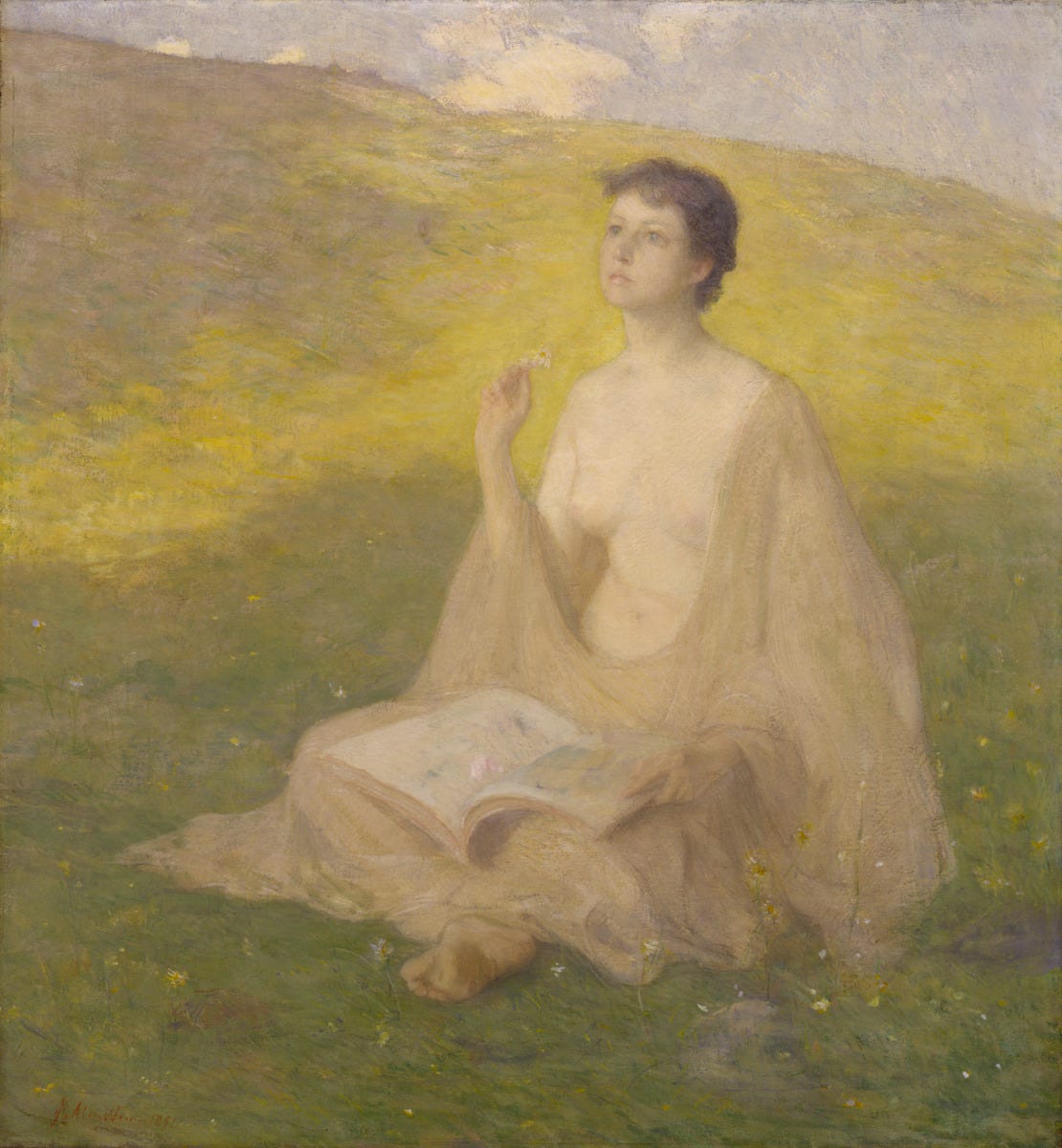
J. Alden Weir, “The Open Book” (1891), courtesy of the Open Access collection of the Smithsonian Museum (Smithsonian American Art Museum, Gift of John Gellatly).
It is important to grasp that this is the structure of the dependence, not the dependence itself; being able to capture existential dependence in this form is a necessary condition, not a sufficient one, for the dependence itself.
Amie L. Thomasson, Fiction and Metaphysics, Cambridge University Press (New York: 2008) pp. 35-36.