
William James's Many Worlds
James on the Sense of Reality
One of the perennially interesting discussions in William James’s The Principles of Psychology (1890) is Chapter XXI, on the perception of reality and belief (where ‘belief’ means “the mental state or function of cognizing reality"). It will go on to some significant influence on certain parts of later phenomenology, and is an interesting attempt to make sense of the various complications associated with talking about what is real.
As far as analysis goes, James says, there is a limit to how much we can say about our sense of reality; James wants to say that it is a matter of feeling, something like a mental consent in which we have a stable idea that eliminates unrest or agitation of mind. Beyond this, it’s difficult to give any account of the feeling itself. More can be said of the psychological history, that is, the conditions and circumstances, of the sense of reality, however.
On this point, James proposes a key idea: “Any object which remains uncontradicted is ipso facto believed and posited as absolute reality” (James’s emphasis). In ordinary circumstances, we only take things to be ‘unreal’ if something about them or their circumstances unsettles us. One of the implications of this is that unreality is always comparative; likewise, when a proposition is not believed, this unbelief is always relative to some other propositions. People disbelieve their dreams only on comparison to waking life; they distinguish fantasy and the real world by contrast.
When something is disregarded as unreal, it is common to treat it as if it had no sort of reality at all, but as James notes there had to be something to disregard, and to give a full account, we want to know how it relates to the things we don’t disregard. Given that James thinks that the disregard is comparative and relative, we also don’t to assume without proof that something unreal relative to one set of things is unreal simply speaking. Because of this, James posits a number of ‘worlds’, or ‘sub-universes’, that make up the world as the human mind actually discovers it:
(1) The world of sense, i.e., physical things as we instinctively find them.
(2) The world of science, i.e., physical things as explained by theories based on experiment and observation.
(3) The world of ideal relations, or abstract truths.
(4) The world of ‘idols of the tribe’. (The term comes from Francis Bacon). These are standing illusis or biases of the human race in general.
(5) The worlds of faith and myth, with which James lumps what he calls the “worlds of deliberate fable,” that is, worlds of fiction.
(6) The worlds of individual opinion.
(7) The worlds of madness.
Part of the way we make sense of our experience is by classifying and re-classifying things under these various ‘worlds’. Everything “settles into our belief as a common-sense object, a scientific object, an abstract object, a mythological object, an object of some one's mistaken conception, or a madman's object; and it reaches this state sometimes immediately, but often only after being hustled and bandied about amongst other objects until it finds some which will tolerate its presence and stand in relations to it which nothing contradicts.” That is to say, these are not, even the physical world of sense or science, written into our experience in a directly identifiable way; we organize these worlds as kinds of categories for making sense of experience that does not come pre-organized in this way. Each category, however, is full of things that are real with respect to other things in the category, and things in other categories can be unreal (in the comparative sense previously noted) when we’re primarily engaging with things classified elsewhere.
However, in terms of the organizing of our experience, habits of mind lead us to give a preference to one world or another across a wide range of practical activities. This world is thus used to organize the others; it is the world of final appeal. This doesn’t, again, eliminate the reality of other worlds, although it contextualizes them and subordinates them. The world of the senses is the default final-appeal world for most people, and for most practical purposes provides a reference point for the reality of other worlds.
On this basis, James argues (unsurprisingly, given his broader views) for a pragmatic view of reality:
In the relative sense, then, the sense in which we contrast reality with simple unreality, and in which one thing is said to have more reality than another, and to be more believed, reality means simply relation to our emotional and active life. This is the only sense which the word ever has in the mouths of practical men. In this sense, whatever excites and stimulates our interest is real; whenever an object so appeals to us that we turn to it, accept it, fill our mind with it, or practically take account of it, so far it is real for us, and we believe it. Whenever, on the contrary, we ignore it, fail to consider it or act upon it, despise it, reject it, forget it, so far it is unreal for us and disbelieved.
As James notes, this account has many affinities with Hume’s position on the nature of belief. The major difference is James’s recognition that it requires us to ‘fragment’ what we treat as real, since this is the only way to get a practical handle on the sheer richness of human experience. Very roughly stated, Hume considers the possibilities that belief consists of (1) a joining of an idea of existence or reality to the ideas that are taken to be real, or (2) a sentiment or feeling. If the latter, it could be either (2a) a sentiment or feeling that is separate from what is believed or (2b) the feeling of the ideas of what is believed, themselves. He gives arguments to reject (1) and (2a), leaving (2b), and he argues that for independent reasons (2b) is in fact the most probable explanation of our experience. And (2b) he takes to require us to say that ideas get a ‘vivacity’ or vividness from their connection with present impressions (sensations and passions and the like). While James doesn’t commit to Hume’s more abstract argumentation, he does agree with Hume’s claim that something like this is the most psychologically probable account of what is going on when we take anything to exist or to be real.
Of course, more could be said on this. Hume’s arguments against (1) depend crucially on very strong empiricist principles that are controvertible, and his argument does not recognize the possibility that belief might not be neither conjunction with an idea nor a feeling, but an act or an acquired disposition. James, being a pragmatist rather than a Humean in his empiricism, has a more active view of the mind than Hume, but he also arguably underplays this. James’s account, like Hume’s, is based on very good, close observation of human experience, but both accounts interpret it in ways that are not entirely uncontrovertible.
In any case, we see from this that James takes fictions to be real on the same ground that everything else is real; they are distinguished by usually not being quite as central to our practical life as our sensory reality, but on his account this does not in any way detract their reality when they are relevant and we are absorbed in them. Our experiences and ideas do not come with tags like, ‘This is the really real thing’; rather, we experience many things, having many ideas in response, and how we sort which ones are real and which ones are not depends on how they are related to each other and, even more fundamentally, on what we are doing. This does not make every judgment about reality equally good. A man suffering from delusions and hallucinations will be in a less pragmatically stable and viable position. But James would perhaps also say that it’s nonsense to go around claiming of someone terrified because of his hallucinations that he is not experiencing anything that is really and truly frightening. Understanding his problem requires recognizing that what is frightening him is as real for him as most of our waking world is to us, and for exactly the same reasons. Only when you’ve recognized this can you actually start sorting out the comparative reality of his experience and yours.
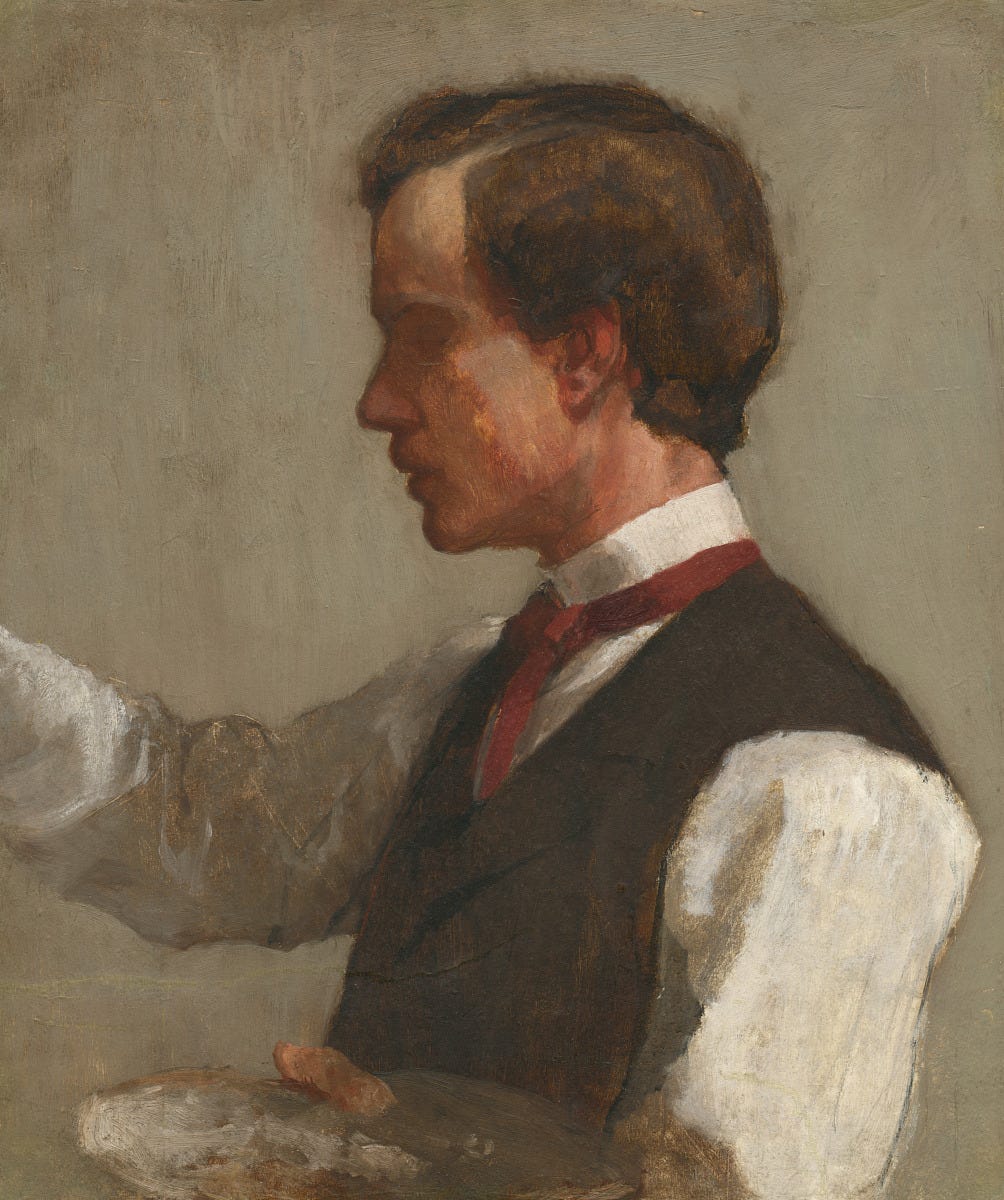
John La Farge, William James (c. 1859), courtesy of the Smithsonian Open Access collection.