
Moral Character, Agential and Attributed
In what way can a fictional person be a good person?
Sir Guy Morville, from Charlotte Yonge’s The Heir of Redclyffe, is a fictional character who famously — and perhaps as importantly, attractively — has an exceptional moral character. When The Heir of Redclyffe was first published, many young readers took Guy as a hero and role model for their own attempts to live morally. This is an extreme case, but it’s clear that one important feature of our reading of fiction is the ability to recognize the moral characters of fictional people. This orients us in terms of recognizing heroes and villains, of course, but it also is a point at which people regularly connect fiction to their own lives.
In what sense do fictional people have moral characters to recognize? There are two different common approaches to talking about moral character. In one, moral character is understood agentially. It is fundamentally a matter of what one actually does. Since fictional people are not themselves agents, it seems reasonable to say that they have no agential moral character. However, there is another way people talk about moral character, in which we consider moral character as attributed. Since fictional people are testimonial objects, this fits them very well. Fictional persons have attributed moral character; they don’t do anything moral, properly speaking, but they have moral actions attributed to them.
Once we make the distinction between agential moral character and attributed moral character, however, the two are much alike in their internal structure. Moral character, whether agential and attributed, has to indicate some habituation of some kind, and it depends on what is actually done or attributed. A common error of authors (certainly in written fiction, but people often complain about it in cinema and other media) is to attempt to attribute to one of their characters a particular moral character while also attributing to them things inconsistent with this supposed moral character; the latter weighs more heavily in attributing a moral character to someone than merely stating something about it. This is tied, perhaps, to the fact that both agential and attributed moral character come in proper and aspirational forms, in which the latter is not necessarily the character one has, but that to which one efforts are oriented. Aspirational forms can be cases of one’s own aspiration for oneself or someone’s aspiration for you. If you simply say that a person in your story is honest, this is attributed moral character, but on its own, it is ambiguous whether this is the moral character they have, or the moral character they are being said to strive to have, or the moral character one hopes as an author that they have. If, however, you depict them as repeatedly doing dishonest things, they have a proper attributed character of dishonesty, no matter how you might try to characterize them as honest — it becomes clear that honesty is just an aspiration for them, and, indeed, may only be an aspiration on behalf rather than an aspiration actually attributed to them.
Thus we can divide up our account of how we talk about moral character in something like the following way:
Agential Character: concerned with how one actually is
     1. Proper Agential Character: based on what one actually does
     2. Aspirational Agential Character: based on aspiration for what one does
               a. On One's Own Behalf: based on what one is trying to be
               b. On Another's Aspiration: based on what others are hoping you will become
Attributed Character: concerned with how one is taken to be
     1. Proper Attributed Character: based on what one is said actually to do
     2. Aspirational Attributed Character: based on aspiration for what one is said to do
               a. On One's Own Behalf: based on an aspiration to be regarded a certain way
               b. On Another's Aspiration: based on what another hopes can be attributed to one
This is quite rough and does not itself cover all cases — for instance, the aspirations in question can themselves be proper or attributed. But the point is that when we are talking about moral character, we can be talking about any of these things, and, importantly for the fictional case, attributed character can be seen as largely having the same structure as agential character. If this weren’t the case, then the fact that fictional persons are testimonial objects and can only have attributed moral character would make it impossible to think of Sir Guy Morville as a heroic role model for oneself, since his moral character would be of a completely different kind from one’s own agential moral character, and therefore he could not be an exemplar for one’s own moral choices.
The agential/attributed distinction and the more-or-less correspondence between the two does not only play a role in fiction, but in ordinary moral life. When we take anyone as a role model, it is specifically an attributed moral character that we are taking as model. Outside of specific contexts, we don’t generally have inside knowledge of someone’s agential moral character, but only of the character that can be attributed to them, associated with the actions that are attributed to them. Taking this attributed moral character as a model, we then use it to guide our actions toward the end of building an agential moral character that corresponds with the attributed moral character we are taking as a model.
It follows, of course, that you, too, have an attributed moral character, just like any fictional person does. Since you also, unlike a fictional person, have an agential moral character, there is an entire class of moral problems that concern mismatch between your attributed moral character, whether proper or aspirational, and your agential moral character — moral problems concerned with hypocrisy, moral failing, and how your choices relate to the expectations of others. For instance, if the moral character you want others to attribute to you differs from the moral character you want to have, this spawns a whole set of moral issues. But sharing with fictional persons the capacity to have attributed moral character is an important part of both moral life and reading.
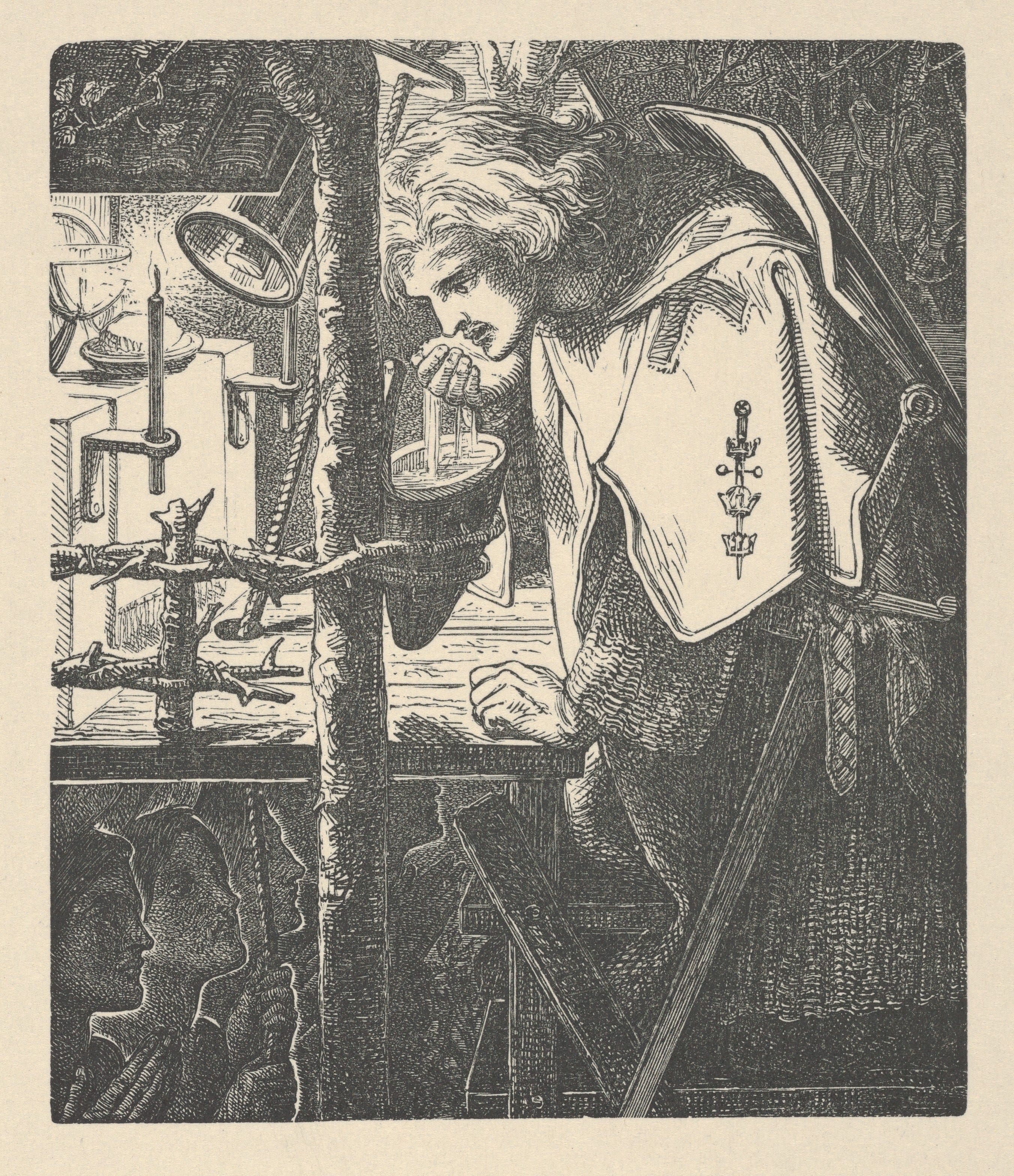
William James Linton, “Sir Galahad” (1903), for an illustration of Tennyson’s poems, after a drawing by Dante Gabriel Rossetti. Courtesy of The Met Open Access Collection.