
Attitudes
Posing for Description
What is an attitude? The term ‘attitude’, used in our everyday sense, arrives fairly late. The term is ultimately from the Latin aptitudo, meaning ‘fitness’ or ‘suitability’ or ‘appropriateness’. In the 17th century, the word developed in the context of the visual arts, particularly painting and sculpture. An ‘attitude’ is a posture or pose that can be captured by the artist to convey a mood. If someone is in an attitude of surprise, they have the kind of posture and pose that indicates that they have been surprised in the specific sense of being confronted with something unexpected. Notice that an attitude in this sense does not necessarily involve anything purely ‘mental’.
What is more, ‘attitude’ in this sense is stereotypical and characteristic, as well as defined relative to the art. We can react in many ways to being surprised by something. But many of these do not count as an ‘attitude of surprise’, because nobody could tell, just from what a painter or sculptor shows, that the subject had been surprised. If you respond to the extremely unexpected with blank shock, the painter might not be able to do anything with it, because it is not distinguishable from shock at many other things. The attitude has to be distinctive rather than multi-purpose. The attitude also has to be paintable (or capturable by another visual art). Necessarily, it is also completely visible. A model for a painting that is intended to show someone in a particular attitude would attitudinize, that is, deliberately pose so as to have the relevant highly-visible posture, facial expression, and so forth.
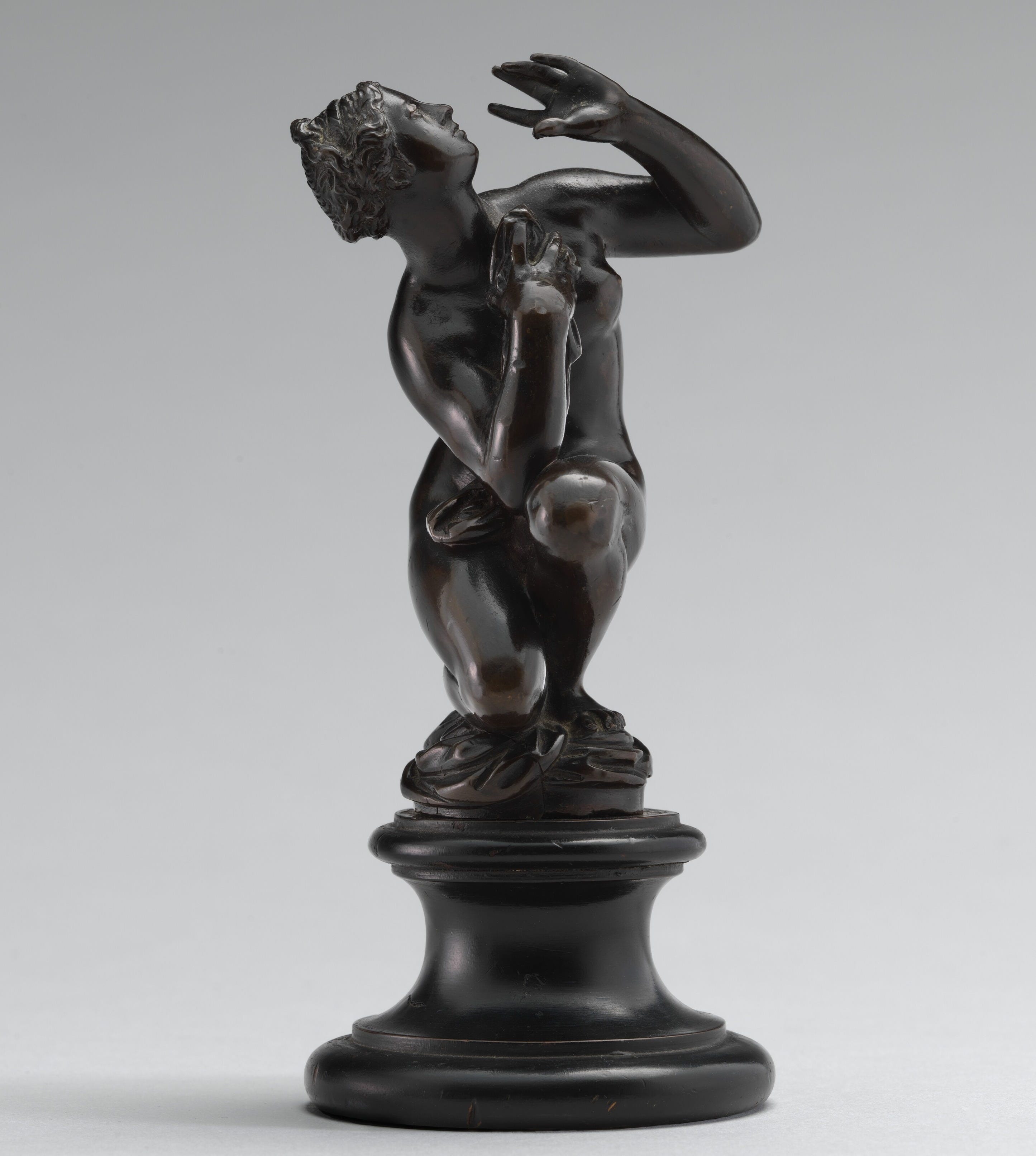
Antonio Susini, “Kneeling Bather Taken by Surprise” (17th century), after 16th century model by Giovanni Bologna, courtesy of the National Gallery of Art Open Access collection, Robert H. Smith Collection.
In the eighteenth century, this artistic term of art began to be used metaphorically to describe the habitula dispositions, involving passions and thoughts, of which these paintable behaviors were suggestive; that is, the attitude (visual sense) was treated as an expressive effect of an attitude of mind, a mental posture or pose, and thence we get the modern notion of a habitual way of thinking or feeling about something. All of this arises in the context of increasing interest in what might be called mental portraiture, found in both early modern philosophy of mind and the rise of the novel as a literary form.
All of this raises an interesting question that we do not think is sufficiently asked. What is an attitude in our modern sense? When we say that somebody has an attitude, of approval or disapproval, say, are we identifying an intrinsic state of mind, which we adapted the artistic term to describe, or are we identifying something that, like the physical attitude, exists relative to an art? The attitude of surprise (painting) is something that is identifiable specifically as paintable; it is not necessarily natural, and you can be in the attitude of surprise in an entirely artificial way. While based on real things, it includes highly conventionalized elements, and involves a certain amount of artificial exaggeration, in order to make it paintable. Could this perhaps be true of attitudes in our sense, as well? That is, while based on some genuine aspects of the human mind, could they perhaps be constructs for the purpose of making literary portraiture (usually verbal, in psychological description and in fiction) easier, in the way that the attitude (in the posture and pose sense) was a specific, deliberate way of presenting the human body to make visual portraiture easier?
People often appeal to attitudes as causes. But are they really? Should we perhaps consider them to be deliberately constructed and attributed ‘poses’ people use to make our descriptions more vivid? In that case, they would often be highly conventionalized (to make communication easier), often exaggerated types (to make them easier to describe), and would really be posited to serve the ends of art rather than always capturing something real. Worth think about, perhaps.